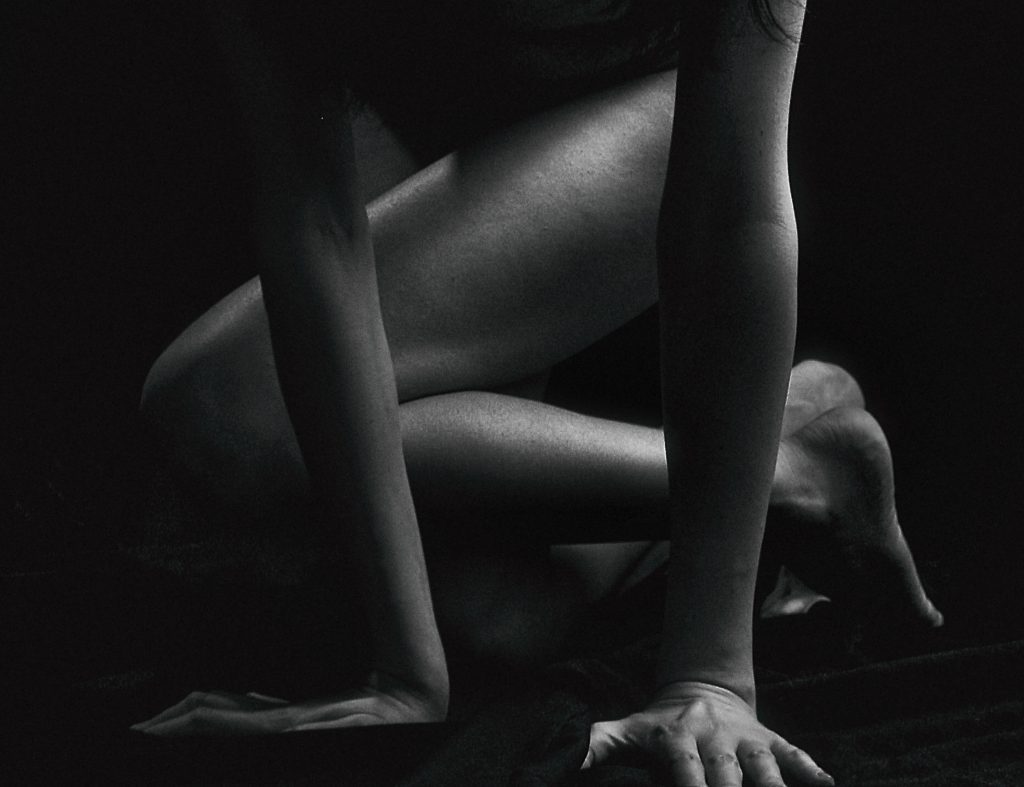
Art is the only acceptable form of public nudity that humans can express, not merely in the literal sense, but in the way that humans expose their souls. Whether a dancer lays her heart bare on a stage or a painter renders an unclothed person, the act of expression is unguarded and raw. Art, unobscured, is not artificial and was never meant to be. It is the natural presentation of the human mind and its trembling emotions. Plato would argue that as a soulless, non-sentient, tiered imitation, Artificial Intelligence (AI) lacks the lived vulnerability to be naked. The fundamental question regarding the inclusion of AI into art must be analysed, for if something is not sentient can it ever truly be naked? And consequently, can it ever truly be art?
Plato (c. 428–423 BC) proposed the existence of two realms: the ‘Realm of Being’ inhabited by perfect, unchanging things, and the ‘Realm of Becoming’, the imperfect world offered to us by our senses. Physical objects in the Realm of Becoming are imperfect copies of the Forms. Plato believes the soul is the immortal bridge that once touched the Forms, and only our souls can ever know the Forms and therefore the real things, as we cannot experience them in the life we know. This spiritual ascension is depicted in the allegory of the cave (2013, 241), where the soul’s education is described as a ‘conversion’ – a painful turning away from flickering shadows on a dark wall toward the true light of the sun. Following that logic, AI couldn’t possibly ever be privy to the Forms; it will forever be a prisoner chained to the back of the cave, analysing the movement of shadows it can never truly see, for it lacks the ‘divine element’ of a soul required to turn toward the light of reality and thus attempt the human vulnerability that is art.
Art is the expression of human imagination and creative skill (OED, 2022). Art’s ‘nudity’ stems from its vulnerability and connection to the soul. Physical objects in our world are imperfect reflections of Forms; therefore, Art is ‘mimesis’, a copy of a copy, and twice removed from the Forms, which are accessed by our souls.
The soul, defined as the spiritual or immaterial immortal part of a living being (Plato, 2013, 237, 349, 370), belongs only to living beings. AI, by contrast, is a tool created by humans. If art’s authenticity lies in the baring of the soul, then AI, which lacks a soul, can only simulate the metaphorical gesture of undressing without ever actually being exposed.
Plato’s aesthetic theory is based on the thought that art imitates the world (Verdenius, 1962). Art is a copy of an imperfect copy of the Forms. In this hierarchy, AI does not even imitate the real object we perceive. AI imitates human-made art, making AI-generated art a copy of a copy of a copy. Just as a painting of a nude body is not an actual body but its representation, AI-generated art is clothed in borrowed data and never laid bare. This tiered imitation pushes the concept of AI further away from the Realm of Being.
AI is a technology that enables machines to simulate aspects of human cognition (IBM Data and AI Team, 2023). Pei Wang (2019, 1-2) defines intelligence in AI as the act of “adaption with insufficient knowledge and resources”.
I believe that while AI mimics the layout of human creativity, it cannot replace genuine emotions, symbolism, or lived experiences that define true artistic expression.
Considering the penetration of AI into art, Plato’s framework of ‘Mimesis’ remains relevant in the inclusion of AI into aesthetic philosophy. However, the framework requires evolution. Because AI-generated images are classified as imitations by non-sentient agents, we might introduce a new category – synthetic mimesis. The word ‘synthetic’ refers to something that is made artificially (OED, 2022). Synthetic mimesis is thus the production or generation of works that resemble art yet are generated by algorithms that do not possess consciousness, emotion, or a soul. AI may function as a tool that reflects collective datasets and algorithms back at the user, but it is not ’nude’ – the generated response is not vulnerable, and it cannot act to lay itself bare. To mistake the new category of synthetic mimesis with authentic art risks displacing the very essence of human expression.
I argue that AI is motivated by commands and not a desire to express itself. It does not create with the intention of being ‘naked’ or exposing vulnerability via artistic expression. AI-generated art can thus be dubbed as a process with the goal of execution rather than vulnerable expression. When AI generates an image, it does not experience the world it depicts; it mathematically analyses databases of pre-existing images and recreates combinations that align with the prompt.
The central thesis of this discussion could be challenged with this question: does art only belong to humans? The natural world often serves as inspiration for artistic expression. A painter might be roused by a beautiful landscape, while a musician might take inspiration from birdsong. In The Republic, Plato critiques human-made art as insignificant and “thrice removed from the truth”; he argues that a painter who renders a bed is merely creating a “semblance of existence” – a copy of the physical bed made by the carpenter, which is itself an imperfect copy of the eternal form. By this logic, nature is an ‘art’ produced directly by the ‘natural maker’ (God), emphasising its inherent reality.
Since nature isn’t human, why and how is it that art is ‘nude’? And if nature doesn’t have to be ‘nude’ to be ‘art’ does that not allow for AI to be considered art? Nature is distinguished from AI because everything that occurs to shape the art of nature is natural expressions, arising from living beings with biological drive. Plato’s dismissal of the imitative artist (2013, 349) stems from the fact that the artist knows nothing of “true existence” (2013, 340); he is a wizard who deceives simple people with images, and such art appeals to the “inferior part of the soul” (2013, 349) rather than the rational mind. AI, however, lacks even this ‘inferior’ human quality; it is a non-sentient tool that functions solely on human input. Whereas the human artist at least attempts a ‘baring of the soul’, AI produces a synthetic mimesis. Even though art does not only belong to humans, the perceived ‘nudity’ of nature is raw and unmediated, while AI is forever trapped in a cycle of artificiality and command.
While writing this essay, I found myself constantly questioning vulnerability. The more capable AI becomes at imitating human creativity, the more it forces us to ask what we value in art itself. Is it the presentation, the sound, the text, or the human exposure behind it? Reflection on this tension made me realise that what we recognise as art may be less about skill and more about the willingness of a human being to reveal something of themselves.
I believe that using AI to generate art is like holding up a mirror in a room of mirrors: it creates appearances of appearances, capturing reflections of the sun, the earth and humanity, without ever having seen the light.
Works Cited:
Oxford University Press. 2022. Oxford English Dictionary. 10th ed. Oxford: Oxford University Press.
Plato. 2013. The Republic. Translated by Benjamin Jowett. Moscow: Roman Roads Media.
University of Plymouth. 2024. Is AI-generated art actually art? [Online]
Available at: https://www.plymouth.ac.uk/discover/is-ai-generated-art-actually-art
[Accessed 05.09.2025].
IBM Data and AI Team. 2023. Understanding the different types of artificial intelligence [Online]
Available at: https://www.ibm.com/think/topics/artificial-intelligence-types
[Accessed 25.09.2025].
Verdenius, W. J. 1962. Mimesis: Plato’s Doctrine of Artistic Imitation and Its Meaning to Us. 1st ed. Utrecht: E. J. Brill.
Wang, P. 2019. On Defining Artificial Intelligence. Journal of Artificial General Intelligence 10(2): 1-37.

By Jenna Wilkinson
Jenna Wilkinson is a second-year student at North-West University, Potchefstroom. A published Afrikaans writer, her work has appeared in anthologies since 2020. In her first year in 2025, she won an undergraduate philosophy essay competition for her work on an improved framework of Plato’s Mimesis and AI. She hopes to pursue philosophy of aesthetics and literature.