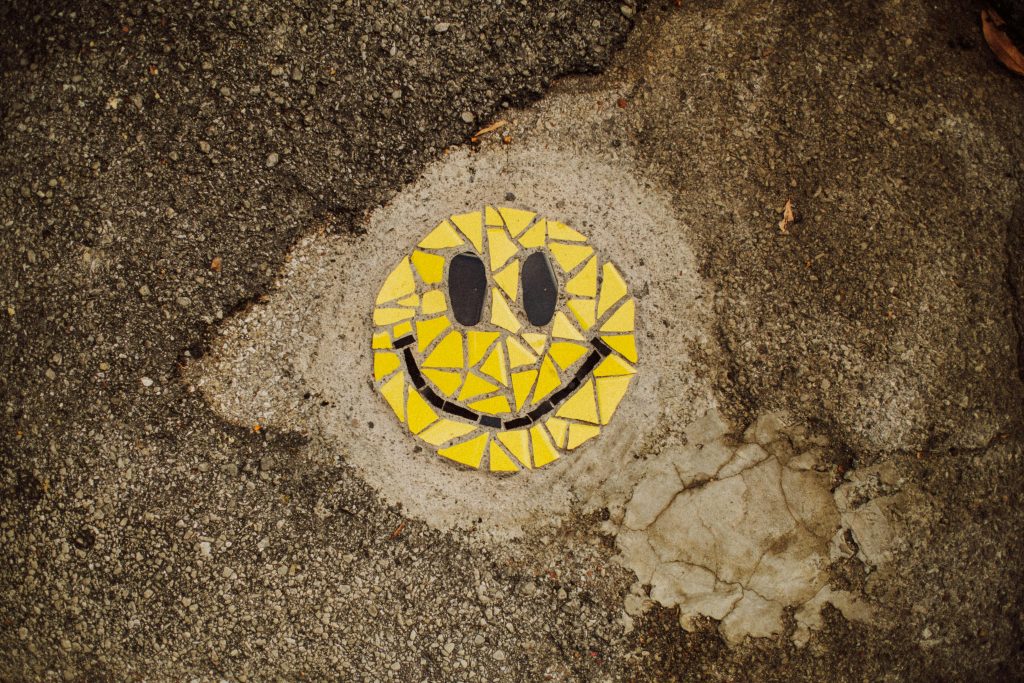
One day, a dear friend of mine remarked that I have an ‘Instagram smile’ as well as a ‘real-life smile’. Her remark made me think: could a smile engage in distinctive modes of smiling? As the more philosophically inclined member of the friendship group, I set out to expand upon the notion of smiling and how to relate to it in the 21st century; here is what I discovered.
I discovered two contrasting narratives of social media, which the delineation of an ‘Instagram smile’ and ‘real-life smile’ evokes. The first paints social media as a self-contained and solitary space for human expression and enterprise. This view of social media is gaining popularity as social media influencers are becoming mainstream. In this separate space, individuals are able to experience a form of life that is independent from their daily lives. The social media world exists alongside the real world of Instagram users. The second, which reflects my initial attitude to social media, sees a ‘selfie’ or a post on an Instagram page as an extension of social media users’ real life. Social media forms part of, and functions in conjunction with, daily life. Instagram offers digital tools to enhance actual human realities by chronicling and capturing lived experiences.
This clarification of social media as either an extension and enhancement of my human existence, or a separate virtual reality, led me to reconsider how social media appears in human existence. Martin Heidegger’s publication, Being in Time (1962), argues for an ‘ontological pluralism’, which means there are different ways human beings can be, and exist within, the world (Heidegger, 1962, 79-80, 83; McDaniel, 2009, 290; Turner 2010, 5; McDaniel, 2010, 688; Vial Vial, 2025, 179; Wrathall, 2025). For Heidegger:
Being-in-the-world has always dispersed [zerstreut] itself or even split itself up into definite ways of Being-in. The multiplicity of these is indicated by the following examples: having to do with something, producing something, attending to something and looking after it, making use of something, giving something up and letting it go, undertaking, accomplishing, evincing, interrogating, considering, discussing, determining …. All these ways of Being-in have concern as their kind of Being. (Heidegger 1962, 83)
I draw upon Heidegger’s concept of ‘Being-in’ to reimagine an ‘Instagram smile’ as being-in both the real and virtual world. My ‘Instagram smile’ offers an entry into a type of cyber presence. The activities of posting, commenting, sharing, tweeting, liking, etc. are all ways in which humans nurture and tend to our cyber presence. These acts of digital caretaking echo the concern that typifies Being-in. Through the lens of Heidegger’s ontological pluralism, my ‘Instagram smile’ is reinterpreted as an instantiation of my being. Humans are concerned with their cyber presence because it offers additional ways and spaces for humans to be, exist within, and present themselves to the world.
Humanity needs ethics that guide us in existing within and through social media and enlighten our concern with our cyber presence. My ethics of a cyber presence focuses on the aspect of self-esteem, rather than guidelines on an effective and safe way to use social media as contained in copious internet articles. My discussion focuses on sentiments linked to feelings of low self-esteem associated with frequent social media use (Woods & Scott, 2016, 41; Jan et al., 2017, 329). This sentiment warrants my further consideration, not because I deem it the only or most important, but rather because I seek guidance as I frequently encounter feelings of inferiority as a consequence of the unrealistic, and sometimes even unhealthy expectations relating to body image and lifestyles disseminated via social media platforms. I call upon all to take up arms in the battle against low self-esteem; actively forming societies where good self-esteem is not only encouraged but also something to strive for.
Creating a world where, in the words of the Canadian-American psychotherapist Nathaniel Branden, “the reputation we acquire with ourselves” becomes our most sought-after possession (Branden 1995, 74). A good self-esteem will allow individuals to be more grounded in, and content with, who they are and, as a result, less willing to compare their mundane existence to the daily influx of picturesque depictions of the once-in-a-lifetime experiences shared on social media. We should cultivate our unique passions and interests, find our happiness and joy, and seek love for ourselves within ourselves. A society centred upon achieving self-esteem also safeguards self-esteem because, in realising self-worth and dignity from the inside out, one ultimately becomes unconcerned with society’s opinions, which, in any case, are beyond individual control. Taking up this resolve to love and respect yourself is not an easy one; it takes hard work, and we will experience several personal defeats because of the constant stimulus from social media, but the gains make the effort worthwhile. We will gain a world in which we all have self-esteem, regardless of how we exist; a world capable of capturing all smiles, whether on Instagram or in real-life – what an enchanting existence!
Works Cited:
Branden, N. 1995. The Six Pillars of Self-Esteem. New York: Bantam Books.
Heidegger, M. 1962. Being and Time. Translated by J. Macquarrie & E. Robinson. Oxford and Cambridge: Blackwell.
Jan, M., Soomro, S.A. & Ahmad, N. 2017. Impact of Social Media on Self-Esteem. European Scientific Journal 13(23): 329 – 341.
McDaniel, K. 2009. Ways of Being. In: Chalmers, D. Manley, D. & Wasserman, R. eds. Metametaphysics: New Essays on the Foundations of Ontology. Oxford & New York: Oxford University Press. pp. 290–319.
McDaniel, K. 2010. A Return to the Analogy of Being. Philosophy and Phenomenological Research 81(3): 688–717.
Turner, J. 2010. Ontological Pluralism. The Journal of Philosophy 107: 5-34.
Vial Vial, F. 2025. Modes-of-Being and Heidegger’s Ontological Pluralism. Tópicos, Revista De Filosofía 73: 197-229.
Woods, H. C. & Scott, H. 2016. Sleepyteens: Social Media Use in Adolescence is Associated with Poor Sleep Quality, Anxiety, Depression and Low Self-Esteem. Journal of Adolescence 51: 41-49.
Wrathall, M. 2025. Martin Heidegger. The Stanford Encyclopedia of Philosophy [Online]. Available: <https://plato.stanford.edu/archives/spr2025/entries/heidegger/>. [Accessed: 13.05.2024]

By Gisela Diedericks
Gisela Diedericks is a philosopher interested in how power operates in both emancipatory and oppressive forms, ranging from the affirmation of rights and dignity to crime, corruption, colonialism, and cults. This reflects her academic background in both law and philosophy. Her work engages Hannah Arendt, Michel Foucault, Judith Butler, Achille Mbembe, Aníbal Quijano, and Frantz Fanon.