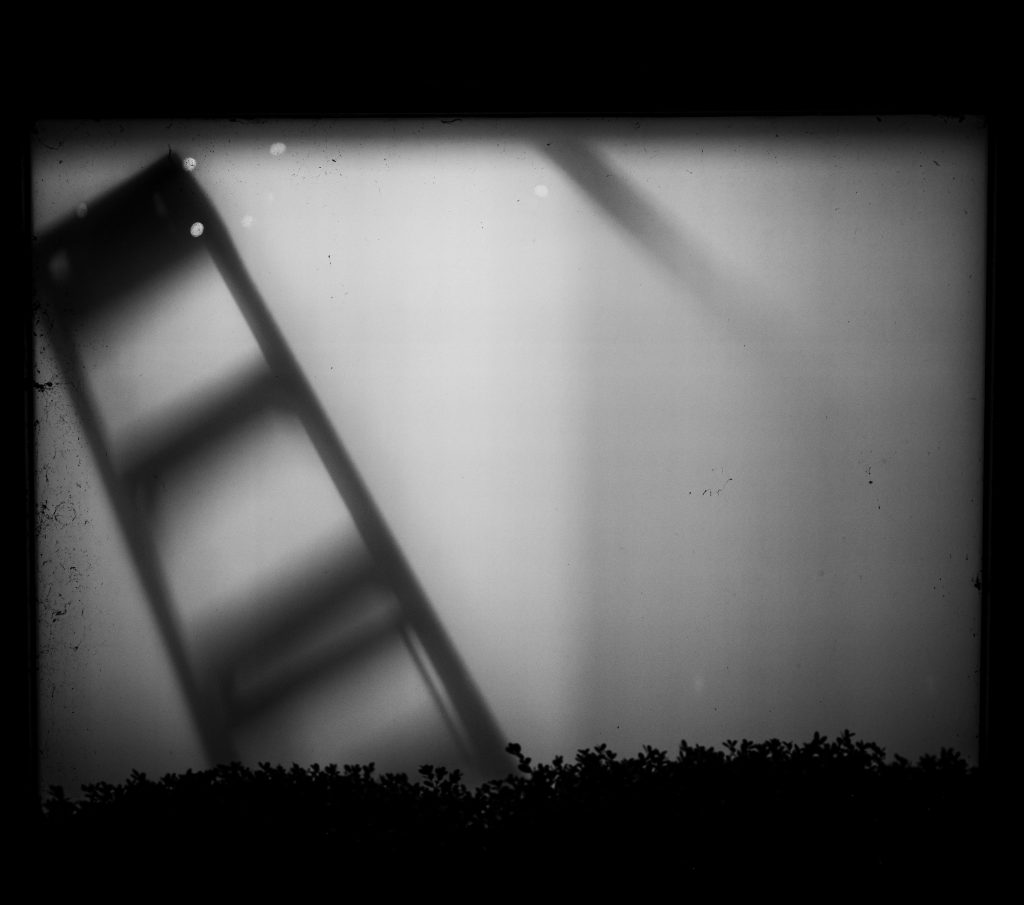
A city is a space of immense hidden parts. The built environment that people notice or engage with is only part of a vast, sprawling whole. In our day to day, we do not think about the deep infrastructural systems, nor are we aware of the complex and conflicting decisions that shape the making of a city-space. So much goes unnoticed, as much of our focus is on the routine of urban living. Sometimes, though, we might stumble across, or over, something strange and unusual. These things might be more deliberate: bad public art, sloppy graffiti, or flourishes of architectural hubris; but at other times, these are perplexingly undefined – ‘anti-architecture’, a seemingly pointless bit of design. If you see something like that, you might very well be looking at a ‘Thomasson’, or ‘hyperart’.
A ‘Thomasson’, or ‘hyperart’, is a term used for a variety of vestigial or leftover constructions or objects found within the built environment. It is not to be confused with debris or rubble or ruins. A ruin is something more obvious: the testament of what was; rubble, the end of all things built. But a Thomasson? That is an altogether separate thing.
The concept of the Thomasson was developed by Japanese artist Genpei Akasegawa. Akasegawa was part of a Neo-Dadaist collective in Japan but he also worked as an illustrator and photographer. It is perhaps his conceptual, creative background that led to his keen eye noticing the unusual, and therefore to his attempts to spot and codify a variety of urban structural forms that have earned the label of ‘hyperart’.
Take his first observation: a staircase at a small hotel he was staying at. One day, while out for a walk, he noticed the short, mirrored staircase at the back of the building. It led up along a wall to nowhere; once one reached the top, one simply walked down again. It was a pure staircase – “le stairs pour le stairs” (Akasegawa, 2009, 8). Akasegawa could only explain its presence in part – that it had once led to an entrance that was now sealed off. There was a detail that bothered him, however: a bit of the wooden banister that had been damaged was recently repaired. For him, this was the detail that set it apart from any number of the defunct or redundant parts of a building that are forgotten. Someone had taken the time to work on this useless object, and to fix it up. It was after encountering other objects that had undergone a similar pointless process of creative attention, such as an old gate or a sealed off ticket office, that he started to develop the idea of hyperart.
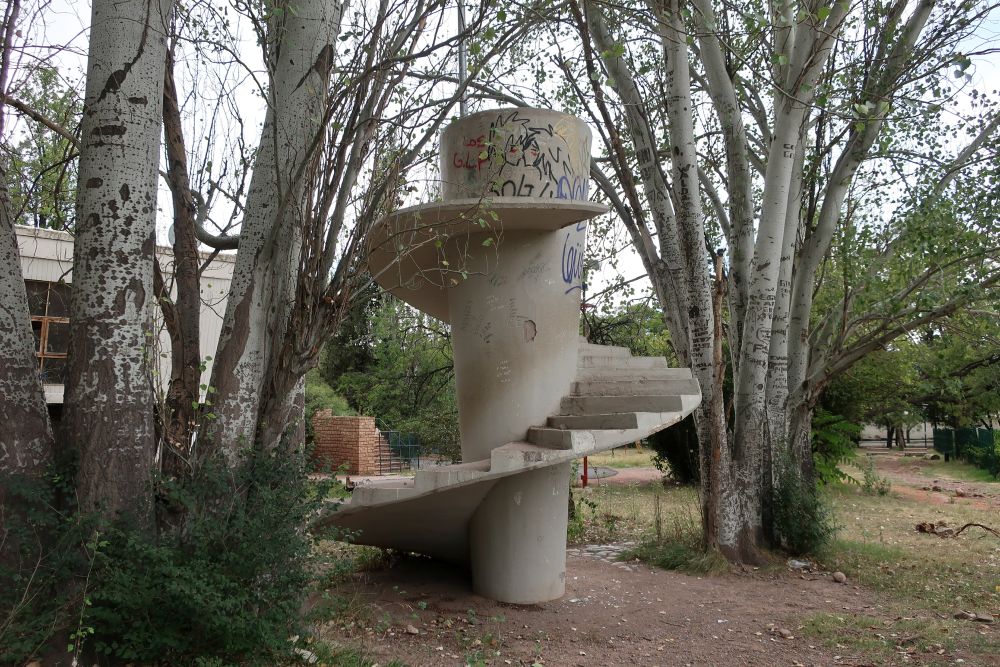
A Thomasson. Image: Daniel Rathbone.
Hyperart, in the strictest sense, is defined as “a defunct and useless object attached to someone’s property and aesthetically maintained” (Akasegawa, 2009, 17). A ‘useless object’ is one that no longer serves a direct function, like the stairs to nowhere. It is something that is left over as the built environment changes around it. Yet, it is not left to decay, but given a strange, second life. The important point here, that it is seemingly maintained, is what gives it the aesthetic quality that sets it apart from other ruins and wrecks found within a city. Finding beauty in incongruity and pointlessness is what makes something hyperart.
Akasegawa’s naming of these objects as ‘Thomassons’ was inspired by American baseball player, Gary Thomasson. A figure of “living hyperart,” Thomasson was a batter signed on to the Japanese teams, the Yomiuri Giants (Akasegawa, 2009, 19). Despite a fortune paid to bring him on, he famously never once struck the ball during his time with the team, designating him a ”fully-formed body [that] served no purpose to the world” (Akasegawa, 2009, 17).
Akasegawa created the Hyperart Thomasson Observation Centre where he documented objects he found, as well as received submissions from other intrepid hyperart observers. Here, he came up with different categories: ‘useless stairs’, ‘closed gates’, ‘ghost windows’, and ‘atomic Thomassons’, which is the lingering imprint of a previous building found on the wall of an existing construction. These are just some of the examples of the ever-expanding categorical types that have come to be observed.
The act of searching for Thomassons has kept me engaged ever since I first encountered the term in Ivan Vladislavic’s Portrait with Keys (2006). While it is easy to come across a seemingly useless object in your neighbourhood, finding a Thomasson is a bit more challenging. It is not something you actively seek for but instead something you notice, almost suddenly, as you come across an object that is not quite right. There is a special thrill in these unexpected discoveries that I think speaks more to the spirit of hyperart than an active hunt does. After all, it is not to be considered a concrete term. As Akasegawa (2000, 189) describes:
[T]he whole idea of hyperart is really just an afterthought. To start with, there’s the chest flutter that you get when you first stand before a new instance. Then there’s the process whereby you realize that the object isn’t a piece of functional architecture, or a tool, or even art. Only then for the lack of a better word, do you end up calling it “hyperart”.
What has drawn me to the idea of hyperart is the way it highlights a particular relationship between people and objects in a built environment. Much of the constant, complex changes in the built environment are obscured by mundaneness. But the incidental nature of a Thomasson draws attention to the often strange choices that have resulted in making something without any apparent use or purpose. As Akasegawa notes, the distinction between art and hyperart is intention: artists make art, while hyperartists create something “without any idea of what they are doing”; what matters is that it is noticed, as “in the end, all hyperart has is the person who discovers it” (Akasegawa, 2009, 16). There is no celebrity creator – only the anonymous assistant who makes it and those who discover it.
This, firstly, speaks to the poetic aspect of what makes the idea of hyperart fascinating: that there exists a relationship between this assistant and the person who discovers the Thomasson. It also addresses the unconscious acts that create a city, and the hard but thoughtless work of creating a pure, pointless object that might never be appreciated. But in the discovery of a Thomasson, there is a moment that arises between people who will never know one another but are still connected by this vestigial object. What untold number of assistants – perhaps even you – are at work right now, creating hyperart for the passing observer?
The beauty of a Thomasson is its fleeting nature, its subtlety. Even when made of steel and concrete (the raw materials of the modern city) it is always something soft, strange, and ephemeral. They appear to those who are willing to look, but they are never there for long. As a place grows and changes, they disappear, only for new anomalies to appear.
Works Cited:
Akasegawa, G. 2009. Hyperart: Thomasson. Translated by M. Fargo. New York: Kaya Press.Vladislavić, I. 2006. Portrait with Keys. Johannesburg: Umuzi.
By Daniel Rathbone
Daniel Rathbone is from Johannesburg. He is currently a PhD student at the University of Warwick with the History of Art department. His research focuses on the history of public spaces and art in urban South Africa during the 1980s.