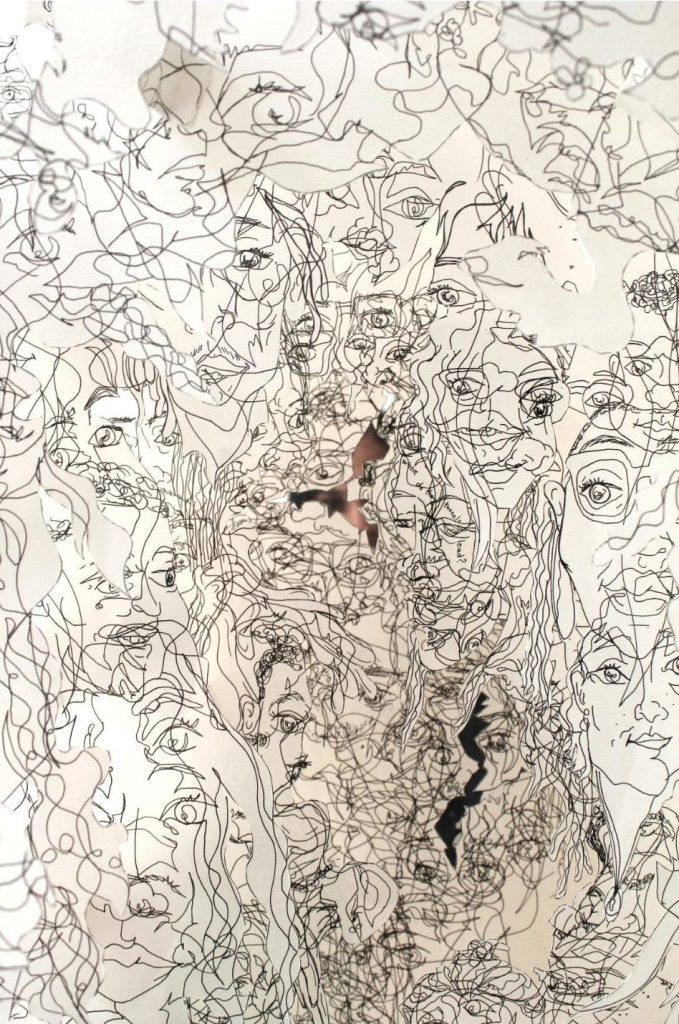
I am a visual artist. I make line-based paper sculptures and through this process, I simultaneously explore the outer world and my inner landscape. My art is detailed and intricate – fine cuts and delicate paper. I often leave traces of my thought process in the work through the use of words. Oftentimes, viewers have found these, and it has slowly become something I leave in purposefully.
These traces or hints are mostly vague – poems or phrases stuck in my head throughout the drawing process. I have come to think of these snippets as a surprise for those who are willing to look closely at my artworks. Viewers also treat it as such, and love to tell me that they saw the words, and how it made them feel. These phrases, sometimes downright depressing utterances, other times entirely mundane, seem to elicit a wide range of emotion in people. Yet they are only one small detail.
These surprises are subtle, and yet often elicit a sense of delight or wonder in those who find them. I do not know whether it is the context of the drawings, the fact that they are not easy to spot (and finding them becomes a treasure, or something only they have noticed), or the emotional load they contain, but I believe that it is this stumbled-upon nature of these small details in artworks that leads to this sense of wonder. According to Sara Ahmed (2013, 179), “wonder is the precondition of the exposure of the subject to the world: we wonder when we are moved by that which we face.” They are something that is stumbled upon – finding them is a momentary glimpse of something slightly more. Something which we notice and explore further. Something that makes us feel things.
In a recent visit to the Magritte Museum in Brussels, I had a moment similar to this with one of René Magritte’s artworks, a painting of a nest of eggs on a ledge. In the background are a horizon of trees, with a night sky above. Outlined in the sky is a bird with clouds in its silhouette. This artwork stopped me in my tracks, making me laugh at first, and then I spotted the name. The Return. Made in 1940. The meaning of the work felt starkly clear, and yet so subtle, only a small detail. It was so simple, a quiet nighttime scene. It did not yell its message, it was more of a whisper. But it left me breathless.
Wonder, in this way, seems to me inextricably linked with subtlety. In life beyond the gallery, one has these moments too. Turning a corner on the street and catching the edge of sunset, or noticing the bristle of leaves in the wind. These are momentary, aesthetic experiences that can catch us slightly off guard, by surprise, and leave us struck with emotion. Ahmed (2013, 180) states that wonder is “learning to see the world as something that does not have to be, and as something that came to be, over time, and with work.” It is the work of looking which can fill us with wonder. It is tied to the amount of attention we give, the way in which we see. The act of looking itself becomes the reward.
As an artist, making spaces of wonder for people to step into is, for me, a broader metaphor for moving within the world. “Wonder expands our field of vision and touch,” states Ahmed (2013, 179). The act of looking through wonder enhances the experience of the senses within the moment. It is also an enhancement of the moment through the senses. Moving closer, leaning in, turning a page, hearing the crinkle of paper, or stepping into an alternative paper-reality: each touch and glance, each step-into has a chance of pulling us into the moment of wonder. These are movements of the body in the world which can create movement of our spiritual or emotional states.
If looking through wonder enhances the senses, the subtle becomes obvious when we are in a state of marvel. Subtlety can move us, can delight. By adopting a state of wonder, the small minutiae of a day can feel like a gift. A ladybug on the door handle, the sight of a rippling shadow creating a tapestry in a parking lot.
It is entirely possible to live without moments where looking becomes wonder. Where the brain completes the picture for us and we do not investigate further. But these small human experiences expand living into deeper, more enhanced moments. By doing so, life becomes more itself. The philosophy of my creative endeavour is steeped in this. To make space for viewers to pause, to look, to become curious and finally to expand their worlds.
Works Cited:
Ahmed, S. 2013. The cultural politics of emotion. Edinburgh: Edinburgh University Press.
By Odette Graskie
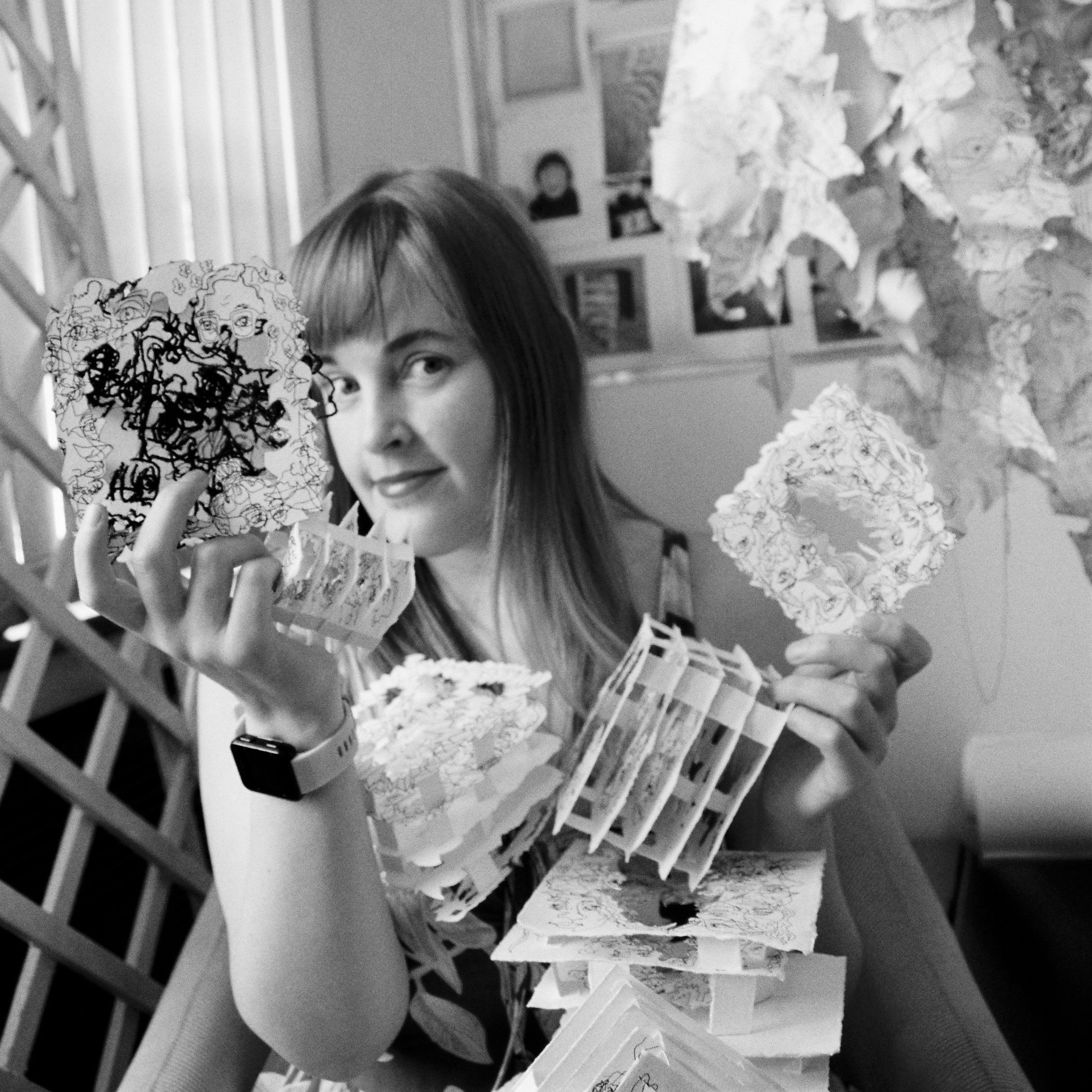
Odette Graskie (b.1993) is a visual artist from Johannesburg, South Africa. Graskie uses paper, drawing, and textile art to create sculptures and interactive artworks that explore memory, emotionality, and intimacy. Her work is often relational, and she is known to invite viewers to participate in performative portraiture drawing sessions.